REFLECTION #9: Explain what your object meant for the people that used it. Is there a modern equivalent?
This pin, or lime dipper (mUlTiPuRpOsEs), is often used for coca ceremonies to extract lime. The head is always decorated as a shaman or a warrior, rarely as a full human (they often have heads looking like a feline or some other animal). There’s also a limited amount of pictures that could be used as the head, which I find interesting because a lime dipper is so tiny and smol, so the fact that the details need to be carefully regarded sort of surprises me (*coughs* I’m sorry, but if only modern society would care more about things- *cough*), as this is only a small portion of the whole ceremony. Now, I’ve actually come across a revelation that this ‘lime’ we speak of here isn’t actually the fruit. I know, I was honestly pretty shocked! The substance is actually powdered lime, which is made from seashells (so delicious-). This lime, combined with the coca leaf, enhances its calming and rejuvenating effects. And the lime dipper? Well the Pre-Columbians liked to spice up their common, everyday utensils, and so these dippers were made (sometimes with the lost-wax casting process) with extra care and attention to details.
Hmm, lime dippers aren’t typically used in the modern household nowadays, but the purpose of the object still remains relevant. I’d say that perhaps similar things could a stirrer or even
REFLECTION #8: Explain how the object was originally made. Explain the process of how YOU made the object in DREAM Lab (and how it is different from the original).
Lime dippers are typically made of gold or tumbaga, an alloy of gold and copper brought by the Spanish inquisitors in Pre-Columbia
Now… let’s face the truth. We’re too broke to afford gold-
Okay, sorry, just kidding! 3D printing gold does indeed exist, and it looks absolutely amazing, but that’s honestly too expensive and extra for a simple 2-day project. (more shall be added, I’m sorry again for this non-productiveness in reflectioning)
REFLECTION #7: Explain what the purpose was for your object. Explain who used it.
The object that I finally decided to create (no, I’m sorry, but Baby Yoda shall come later, possibly for TSA…) are pins (tupùs) or lime dippers. Oui, lime dippers are a real thing, and they are exactly what they sound like. There weren’t a lot of information about these fascinating curios, but it appears that the majority of these special pins come from Calima in Columbia, with some tupùs found in Recuay, Peru. The lime dippers were utilized to dip and administer lime in a coca ceremony, in which shamans use the coca leaf (a popular and ancient leaf that’s used even now) to tell their guests deeper insights about themselves and their possible futures.
(
Lime-dipper, probably used to extract the lime from a gold flask. It is made of gold or tumbaga by lost-wax casting in the form of a long pin with a bell at the upper end. Some of these dippers were also hammered.)
As aforementioned, these pins are usually used in ceremonies where
REFLECTION #6: What do you plan to create for the history project? Explain in detail your ideas. We begin fabrication next class.
After basically taking the whole class to come up with ideas, plus journeying on an enlightenment path to find the holy Pre-Columbian Baby Yoda (pictured below in all his glory, because why not), I think I finally decided what I wanted to do. I kinda wanted to try something with Judaism or Islam in the beginning, but I was quite fascinated by Pre-Columbian art and tool-making, so I went to look up things about that too. First I found the sundial, which I thought would be a cool object to study and create, but then something else kind of caught my eye. I’m… gonna let you guess what beautiful, holy creation walked upon my path of fate.
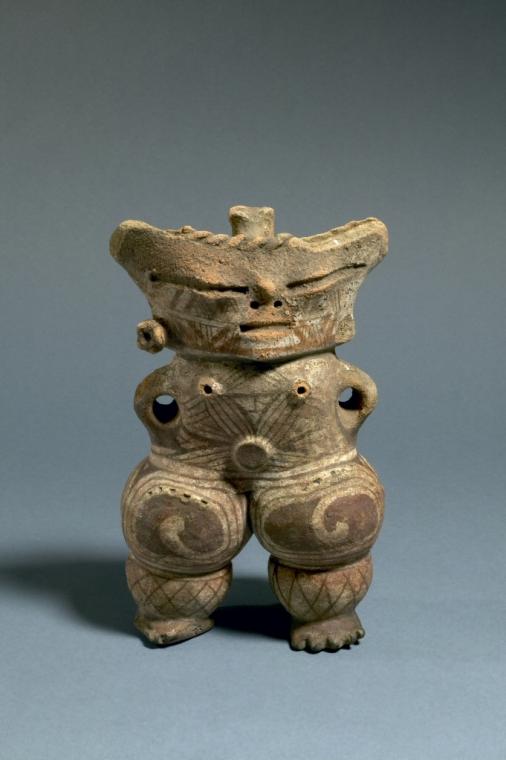
HE IS GRACE
HE IS SQUISH SO I SQUISH HIS FACE
 DREAM Labbing: Cynthia's Blog